
Solar road lights have become a major facility for illuminating urban and rural roads. They are easy to install, require minimal wiring, and convert light energy into electrical energy and vice versa, bringing brightness to the night. Rechargeable solar street light batteries play a crucial role in this process.
Compared to older lead-acid or gel batteries, commonly used lithium batteries offer better specific energy and specific power, are easier to charge quickly and discharge deeply, and have a longer lifespan, resulting in a better lighting experience.
However, there are differences in the quality of lithium batteries. Today, we’ll start by examining their packaging forms to see what characteristics these lithium batteries have and which type is better. Common packaging forms include cylindrical wound, square stacked, and square wound.
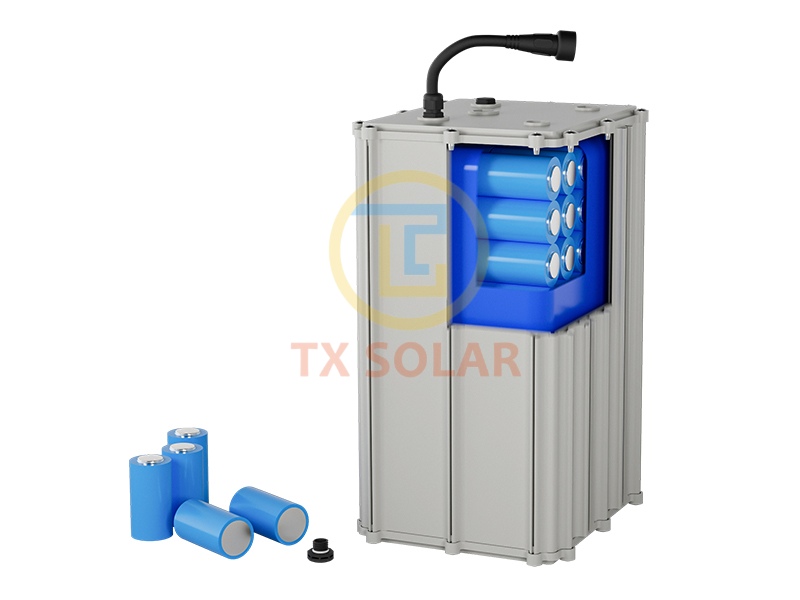
I. Cylindrical Wound Battery
This is a classic battery configuration. A single cell mainly consists of positive and negative electrodes, a separator, positive and negative current collectors, a safety valve, overcurrent protection devices, insulation components, and a casing. Early casings were mostly made of steel, but now many use aluminum.
Cylindrical batteries have the longest history of development, a high degree of standardization, and are easy to standardize within the industry. The automation level of cylindrical cell production is higher than other battery types, ensuring high production efficiency and cell consistency, which also reduces production costs.
Furthermore, cylindrical battery cells have better mechanical properties; compared to the other two types of batteries, they exhibit the highest bending strength for similar dimensions.
II. Square Wound Battery
This type of battery cell mainly consists of a top cover, a casing, positive and negative plates (stacked or wound), insulation components, and safety components. It incorporates a needle penetration safety protection device (NSD) and an overcharge safety protection device (OSD). Early casings were generally made of steel, but aluminum casings are now the mainstream.
Square batteries offer high packaging reliability and better space utilization; they also boast high system energy efficiency, are lighter than cylindrical batteries of similar size, and have higher energy density; their structure is relatively simple, and capacity expansion is relatively convenient. This type of battery is suitable for increasing energy density by increasing the capacity of individual cells.
III. Square Stacked Battery (also known as pouch batteries)
The basic structure of this type of battery is similar to the two types mentioned above, consisting of positive and negative electrodes, a separator, insulating material, positive and negative electrode tabs, and a casing. However, unlike wound batteries, which are formed by winding single positive and negative electrode sheets, stacked batteries are composed of multiple layers of electrode sheets.
The casing is primarily an aluminum-plastic film. This material structure has an outermost nylon layer, a middle aluminum foil layer, and an inner heat-sealing layer, with each layer bonded together with an adhesive. This material has good ductility, flexibility, and mechanical strength, exhibits excellent barrier properties and heat-sealing performance, and is also highly resistant to electrolytes and strong acid corrosion.
Soft-pack batteries utilize a stacked manufacturing method, resulting in a thinner profile, the highest energy density, and a thickness generally not exceeding 1cm. They offer superior heat dissipation compared to the other two types. Furthermore, for the same capacity, soft-pack batteries are approximately 40% lighter than steel-cased lithium batteries and 20% lighter than aluminum-cased batteries.
In short:
1) Cylindrical batteries (cylindrical wound type): Generally use steel casings, but aluminum casings are also available. The manufacturing process is relatively mature, offering small size, flexible assembly, low cost, and good consistency.
2) Square batteries (square wound type): Early models mostly used steel casings, but now aluminum casings are more common. They offer good heat dissipation, easy assembly design, high reliability, high safety, include explosion-proof valves, and high hardness.
3) Soft-pack batteries (square stacked type): Use aluminum-plastic film as the outer packaging, offering greater flexibility in size, high energy density, light weight, and relatively low internal resistance.
Post time: Jan-07-2026


