
One of the most crucial components of a solar street light is the controller, which allows the light to turn on at night and off at dawn.
Its quality has a direct impact on the solar street light system’s longevity and overall quality. To put it another way, a well-selected controller lowers overall costs, minimizes future maintenance and repairs, and saves money in addition to guaranteeing the quality of the solar street light itself.
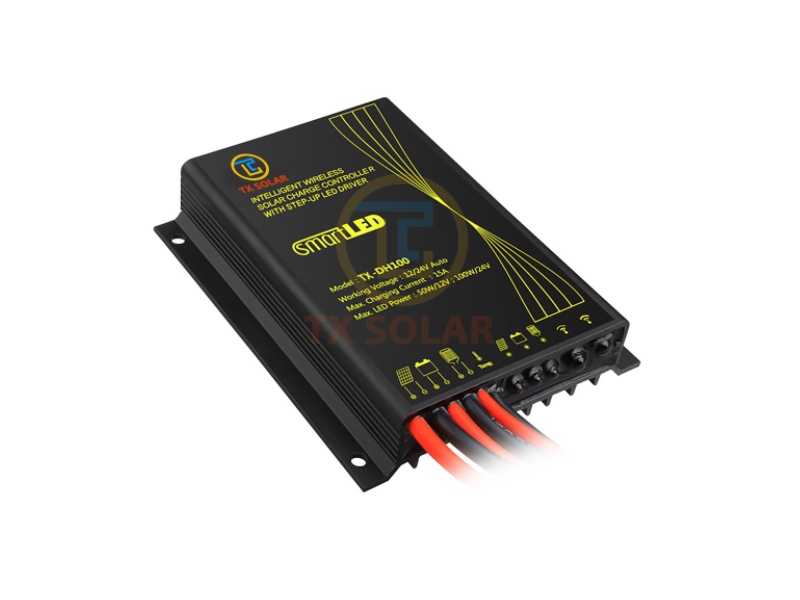
What is the best way to select a solar street light controller?
I. Controller Output Type
When sunlight shines on a solar panel, the panel charges the battery. However, it’s important to note that this voltage is often unstable, which can shorten the battery’s lifespan over time. The controller addresses this issue by ensuring a stable output voltage.
There are three types of controller outputs: standard output controllers, boost constant current controllers, and buck constant current controllers. The specific type to choose depends on the type of LED light being used.
If the LED light itself has a driver, a standard output controller is sufficient. If the LED light does not have a driver, the type of controller output should be selected based on the number of LED chips.
Generally, for a 10-series-multiple-parallel connection, a boost-type constant current controller is recommended; for a 3-series-multiple-parallel connection, a buck-type constant current controller is preferred.
II. Charging Modes
Controllers also offer various charging modes, which directly affect the charging efficiency of the solar street light. Low battery voltage leads to strong charging. The battery is rapidly charged by the controller using its maximum current and voltage until the charging voltage reaches the battery’s upper limit.
The battery is left to rest for a while after vigorous charging, allowing the voltage to naturally decrease. Some battery terminals may have somewhat lower voltages. By addressing these low-voltage regions, equalization charging brings all batteries back to a fully charged condition.
Float charging, after equalization charging, allows the voltage to drop naturally, then maintains a constant charging voltage to continuously charge the battery. This three-stage charging mode effectively prevents the battery’s internal temperature from continuously rising, better ensuring its lifespan.
III. Control Type
The brightness and duration of solar streetlights vary depending on the location and ambient conditions. This mainly depends on the type of controller.
Generally, there are manual, light-controlled, and time-controlled modes. Manual mode is typically used for streetlight testing or in special load situations. For regular lighting use, a controller with both light-controlled and time-controlled modes is recommended.
In this mode, the controller uses light intensity as the starting condition, and the shutdown time can be set according to specific environmental conditions, automatically shutting off after a set time.
For better lighting effects, the controller should ideally also have a dimming function, i.e., a power-sharing mode, which intelligently adjusts the dimming based on the battery’s daytime charge level and the lamp’s rated power.
Assuming the remaining battery power can only support the lamp head operating at full power for 5 hours, but the actual demand requires 10 hours, the intelligent controller will adjust the lighting power, sacrificing power to meet the time requirement. The brightness will change with the power output.
IV. Power Consumption
Many people believe that solar streetlights only start working at night, but in reality, the controller is needed to control battery charging during the day and to control the lighting at night.
Therefore, it operates 24 hours a day. In this case, if the controller itself has high power consumption, it will affect the power generation efficiency of the solar streetlight. Therefore, it is best to choose a controller with low power consumption, ideally around 1mAh, to avoid consuming too much energy.
V. Heat Dissipation
As mentioned above, the solar street light controller works continuously without rest, inevitably generating heat. If no measures are taken, this will affect its charging efficiency and lifespan. Therefore, the chosen controller also needs a good heat dissipation device to better ensure the efficiency and lifespan of the entire solar street light system.
Post time: Jan-08-2026


