
When purchasing LED street lights, most engineering contractors focus on wattage, luminous efficacy, and chip brands. However, a factor that is often overlooked but directly determines the actual road performance is the installation angle – specifically, the inclination angle of the lamp housing relative to the road surface.
The physical principle behind the angle
LED street lights are directional light sources. Unlike traditional high-pressure sodium lamps that emit a relatively broad light pattern, LED lighting lamps rely on secondary optical lenses to shape a precise rectangular beam that extends along the road. This beam shape is designed for a specific inclination angle – typically from the horizontal direction upwards by 0° to 15°.
When the LED lighting lamp is tilted beyond this design range, two things happen simultaneously: the effective projection distance changes, and the light distribution pattern shifts.
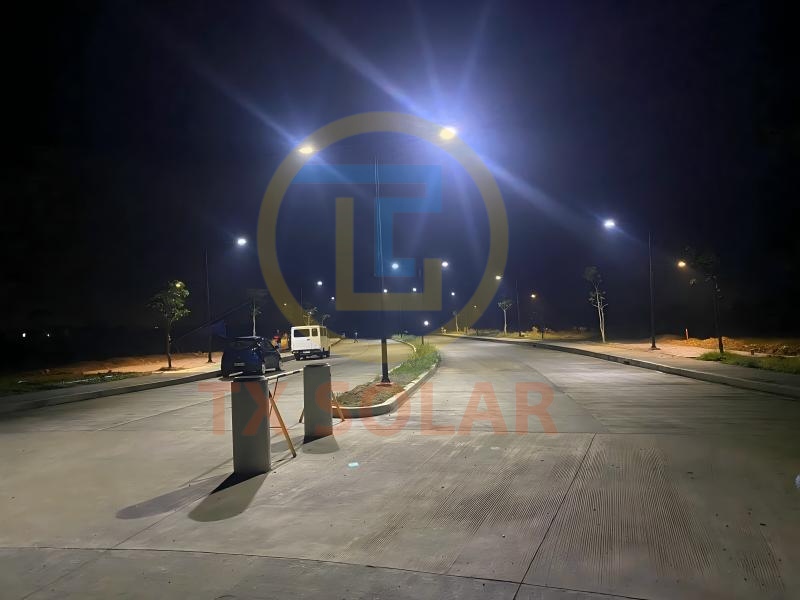
The consequences of improper inclination
Lamps with insufficient inclination (0° or less) often generate concentrated hotspots directly beneath the lamp pole, resulting in dark areas in the middle section between lamp poles. The longitudinal uniformity deteriorates, and drivers experience a “pulsating” visual effect when traveling through alternating light and dark areas.
Lamps with excessive inclination (more than 15°) will direct more light towards the distance. At first glance, it seems to expand the lighting range. However, there is a cost: glare increases sharply. Light emitted at a high angle (80°–90° from the vertical line) directly enters the driver’s eyes, causing discomfort instead of improving visibility. Both CIE and IES recommend that the maximum luminous intensity direction should not exceed 65° from the vertical direction.
A recent simulation study using Dialux software examined the performance of four lamp light distribution at inclination angles of 0° to 15° and installation distances of 0–4 meters from the curb. The results are noteworthy: for some light distributions (R3 and R4), road brightness significantly changes with the inclination angle, being more obvious at larger lateral distances. At the minimum distance, the brightness value produced at a medium inclination angle is the most stable and higher than the required threshold.
Another study targeting a two-way four-lane road found that the best uniformity and glare control is achieved at a specific inclination angle within the standard range – neither 0° nor the maximum value of 15°.
Installation guidelines
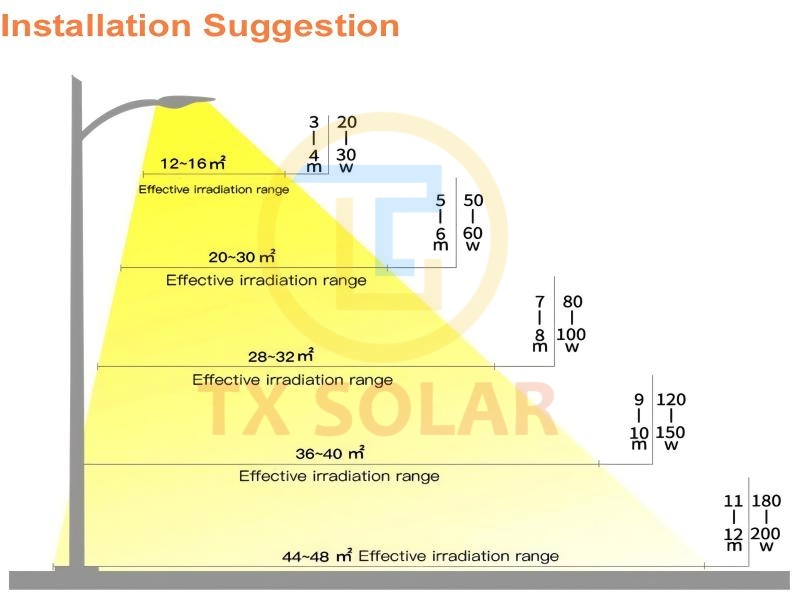
For standard road applications, an inclination range of 0° to 15° is recognized, and the optical design of the lamp determines the optimal point within this range. The cantilever (the horizontal distance from the lamp pole to the lamp light center) should not exceed one quarter of the installation height, as excessive cantilever combined with inclination will cause unpredictable shifts in the ground pattern of the light beam.
For high-pole lighting at intersections or large areas, the maximum intensity should be aimed within 65° from the vertical direction – this requirement is more stringent due to the need to control glare from multiple incoming vehicle directions.
What does this mean for your project?
Two identical LED street lights – with the same wattage and optics – may have measurable differences in road lighting due to different inclination methods. A few degrees of improper inclination can reduce uniformity, increase glare, and prevent the expensive lamps from performing to their full potential.
At Yangzhou Tianxiang Road Lamp Equipment Co., Ltd., our lighting lamps are meticulously designed, with their optical light distribution matching the expected installation angle. We provide detailed luminance files and installation guidance to ensure the claimed performance translates into actual road conditions – not just laboratory curves.
Post time: Oct-16-2026


