
For LED road light manufacturers, export packaging requirements cannot stop at “pack it sturdy.” An effective packaging specification needs to be derived backwards from three dimensions—product risk, logistics route, and destination-country compliance—rather than filling foam at the last minute before shipment. LED street lights have an elongated profile, aluminum heat-sink housings, brittle optical lenses, and sensitive driver electronics. These characteristics dictate that packaging design should start from “preventing specific failure modes” rather than a vague “shock protection.”
First, lock the packaging hierarchy to product identity. A common problem in export projects is mixing multiple wattages or optical configurations in one order. If packaging labels become disconnected from the actual contents, receiving and counting at the destination descend into chaos. It is advisable to build a packaging hierarchy matrix: individual packaging corresponds to a specific model and accessory list, outer carton corresponds to quantity, gross weight and dimensions, pallet corresponds to carton stacking pattern, and customs documents correspond to order number and SKU. Any change at one layer should originate from a controlled source and propagate downstream. For example, changing an installation bracket may simultaneously affect individual net weight, inner liner geometry, outer carton quantity, and even the customs code—the packaging drawing must be updated accordingly.
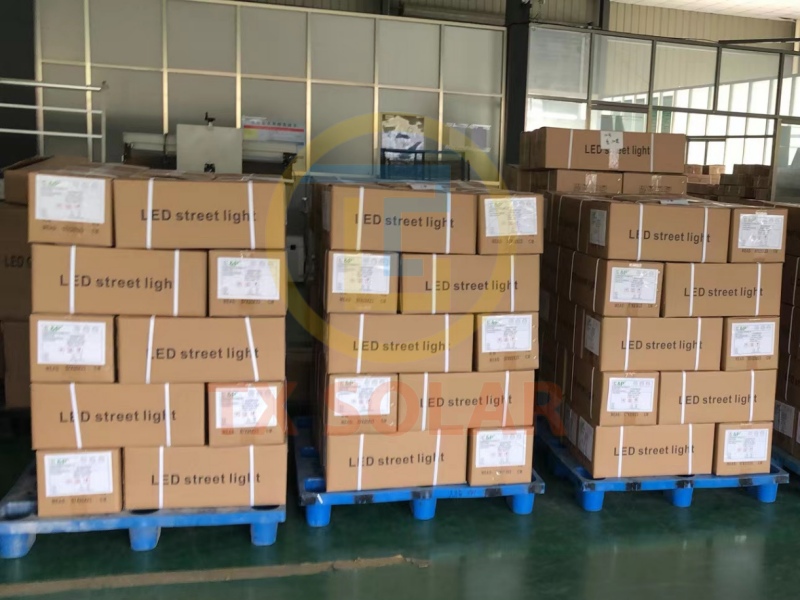
Second, select test procedures based on the actual transport route rather than defaulting to drop testing. Export LED road lights typically pass through factory handling, container sea freight, port lifting, destination-country inland transport, and warehouse stacking. Hazard types include sustained vibration, stacking compression, humidity ingress, and handling impact. The ISTA series divides procedures by logistics scenario—for instance, 3A applies to parcel systems, while 3E addresses unitized loads. Drop testing alone may miss fastener loosening or cable abrasion caused by prolonged vibration. For products like LED road lights with lenses and drivers, post-vibration inspection should check whether internal LED boards have shifted, lenses have micro-cracks, or connectors have come loose—not merely whether the outer carton is damaged. Test records must specify sample configuration, test sequence, and acceptance criteria. Statements like “no damage” are too vague to serve as a repeatable release basis.
Third, ISPM 15 compliance for wood packaging is a step that cannot be skipped. If solid wood pallets or crates are used, confirm whether the destination country enforces the ISPM 15 standard. This standard requires wood packaging to undergo heat treatment (HT, wood core temperature of at least 56°C for a minimum of 30 minutes) or methyl bromide fumigation (MB), and to bear a mark containing the IPPC symbol, country code, treatment provider number, and treatment code. The mark should be applied to two opposite sides of each wood packaging unit in a prominent position—not handwritten, and not in red or orange. Processed materials such as plywood and particleboard, as well as wood materials not exceeding 6mm in thickness, generally fall outside the regulated scope; however, if pallet feet or reinforcement battens are solid wood, they still require treatment. A common export incident: the cargo itself is fully compliant, yet the pallet lacks the IPPC mark and is detained, forcibly treated, or destroyed at the destination port—demurrage costs far exceed the packaging cost.
Fourth, treat pre-packaging inspection as a release gate. Before sealing cartons, confirm that the product version entering packaging has already been released. Inspection items should include at minimum: whether model and wattage match the carton marking, whether the lens surface is scratched, whether the mounting interface matches order requirements, whether the accessory pack quantity is complete, and whether the label version is current. If both old and new versions of manuals or brackets exist on the shop floor simultaneously, they must be segregated and counted before packaging; otherwise, mixed materials will only surface when the customer opens the carton. For export projects, outer carton markings should also include destination-country language requirements, country-of-origin identification, and recycling information—these should not be patched on at customs declaration time.
Finally, packaging drawings and material specifications need to be brought under change control. Cardboard grade, liner material, carton sealing tape, and stacking layer limits should all be recorded in controlled documents. Switching cardboard suppliers or reducing grammage may barely pass laboratory testing yet lose structural support in the high-humidity environment of real ocean freight. Packaging testing is not a one-time pass; whenever product dimensions, weight, or packaging structure change, the verification conclusion must be re-evaluated. For LED road light manufacturers, a packaging specification that withstands destination-port inspection and customer unboxing scrutiny is worth no less than the luminaire’s own certification certificates.
Post time: Oct-23-2026


