
With the improvement of social and economic development and the acceleration of urbanization, residential communities are springing up everywhere. As part of the community’s living environment, community street lighting is receiving increasing attention. How to design community LED street lighting solutions safely, aesthetically, and energy-efficiently according to urban road lighting design standards is an issue that cannot be ignored.
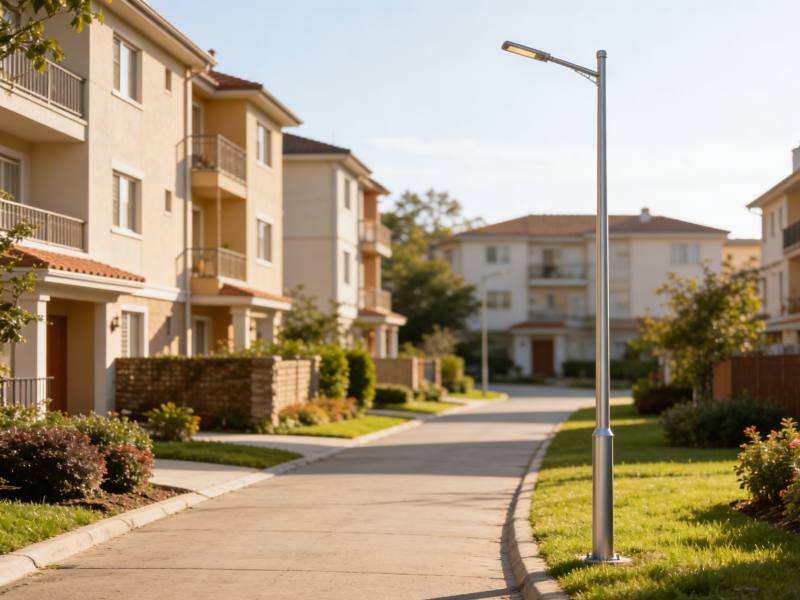
1. Reasonable Arrangement and Selection of Street Lighting Fixtures
There are four basic forms of arrangement and layout of street lighting fixtures in residential communities: single-sided lighting, central lighting (including central single-lamp lighting and central symmetrical lighting), staggered lighting, and symmetrical lighting. Generally, double-sided lighting is used on main roads. Double-sided lighting generally has two methods: symmetrical arrangement and staggered arrangement. Each arrangement has its advantages and disadvantages. Symmetrical arrangement is more aesthetically pleasing, but its disadvantage is that the illumination is not uniform enough, making it suitable for wider roads. While staggered arrangement is not as aesthetically pleasing as symmetrical arrangement, the illumination is more uniform. Considering that the road lighting in residential communities should prioritize aesthetics while meeting functional requirements, some aesthetically pleasing courtyard lights can be selected. The lamp height should be 3-4 meters, and the power of a single light source should not be too high. Lamps should not be installed near windows on the first floor of residential buildings to avoid disturbing residents’ rest.
2. Voltage Stabilization, Voltage Reduction, Dimming, and Energy Saving
In road lighting, the luminous flux of the light source is affected by voltage, resulting in varying road surface illuminance at different times. Evening is peak electricity consumption, when the grid voltage is low, the luminous flux of the light source is low, and the road surface illuminance is low; conversely, midnight is a low-load period, the grid voltage is high, the luminous flux emitted by the light source is high, and the road surface illuminance is high. This unscientific electricity consumption not only wastes energy and increases network losses but also reduces the lifespan of electrical equipment, including lamps. Therefore, installing intelligent light source voltage stabilization and dimming devices at the control end of streetlights helps stabilize voltage, stabilize light source luminous flux, and extend the lifespan of lamps.
3. Selection of Light Source Type
Currently, the main types of light sources used in street lighting include metal halide lamps, high-pressure sodium lamps, and energy-saving lamps (compact fluorescent lamps). Among them, high-pressure sodium lamps have advantages such as high luminous efficiency, energy saving, and moderate color temperature, and are widely used in street lighting. For roads wider than 8 meters, functional streetlights with cut-off or semi-cut-off beams should be considered. In selecting light sources, high-efficiency high-pressure sodium lamps and metal halide lamps should be given priority, with average illuminance generally controlled at 1-5 LX. Energy-saving LED street lighting (compact fluorescent lamps) are used on general roads and secondary roads, with average illuminance lower than that of main roads, generally controlled at 0.5-3 LX. This creates a sense of depth in the entire community and provides a softer outdoor environment for low-rise residential buildings. In green areas, a combination of courtyard lights and a suitable number of lawn lights can be used. Floodlights are generally not considered for environmental enhancement in residential areas, as they can easily cause light pollution to surrounding residents.
Energy-saving LED street lighting within a community is closely related to people’s daily lives. High-quality street lighting design should not only bring convenience to people’s work and life, and a pleasant mood for their travel and leisure, but also pay special attention to requirements such as safety, energy conservation, and environmental protection.
Post time: Feb-06-2026


