
A street lighting project should begin with a question more specific than “How many watts do we need?” The more useful question is: Where does the light need to go?
A narrow residential street, a divided arterial road and a curved approach to an intersection create different lighting tasks. Selecting suitable LED street light optics means matching the light distribution to those tasks, rather than choosing a fixture only by its power or total lumen output. Photometric performance is therefore an essential part of evaluating a luminaire for a particular application.
For contractors and project buyers, the following approach provides a practical starting point for discussing optical requirements with a street light manufacturer.
1. Define the Lighting Area Before Selecting the Lens
The carriageway is not always the entire area that requires illumination. A road may also include bicycle lanes, sidewalks, parking strips, medians and pedestrian waiting areas. These should be identified separately when preparing the lighting design. Road lighting software such as DIALux evo allows these elements to be included in the street profile and evaluated according to their assigned lighting requirements.
For the initial project brief, record the road cross-section together with mounting height, pole spacing, setback from the carriageway and arm projection. Mark any existing poles that cannot be moved.
Consider two hypothetical roads with identical carriageway widths. On the first, luminaires are positioned close to the curb. On the second, they are mounted behind a wide sidewalk. The second arrangement requires light to travel farther laterally before reaching the opposite traffic lane. This illustrates why road width alone cannot determine the correct optic.
2. Straight Roads: Balance Lateral Reach and Longitudinal Coverage
For straight roads, optical selection involves two directions: coverage across the roadway and coverage along the roadway.
Type II distributions are commonly considered for relatively narrow roads and other elongated areas with roadside mounting. Type III distributions provide greater lateral coverage and may be suitable candidates for wider road sections. These classifications help create an initial shortlist; they should not be treated as guarantees that a particular lens will satisfy a project.
When comparing candidates, ask for calculation results at the far edge of the carriageway and between successive poles—not just directly beneath the luminaires. Continuous roadway lighting should provide appropriate coverage along the road, rather than a sequence of isolated bright locations.
A useful review question is: Does this optic reach the difficult areas without unnecessarily overlighting the easy ones?
Increasing output is not a substitute for correcting the distribution. If every calculated illuminance value increases by the same proportion, the ratio of minimum illuminance to average illuminance remains unchanged. More light may raise the overall level, but it does not automatically improve that uniformity ratio.
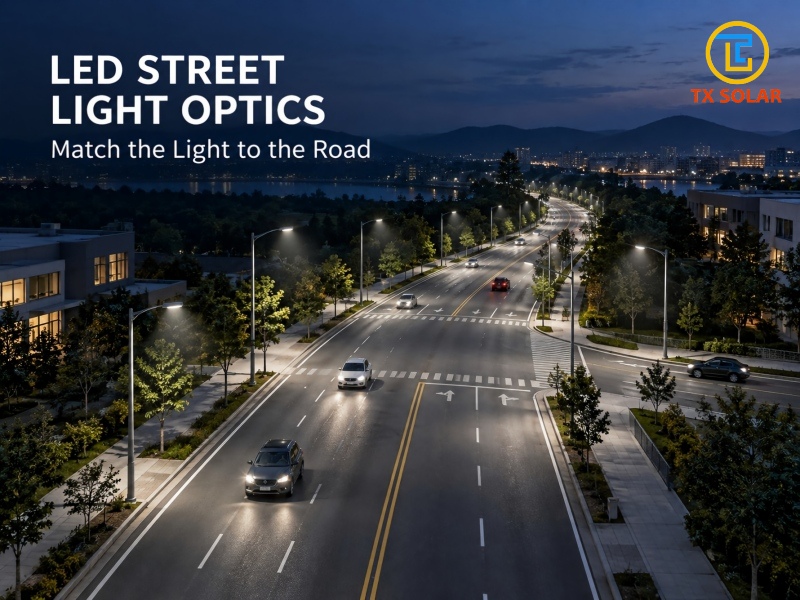
3. Divided Roads: Evaluate Each Carriageway Separately
A divided road should not automatically be treated as one large rectangular lighting area. Establish which luminaires serve each carriageway and how the median affects their positions. Single-sided, opposite, staggered and median-mounted arrangements represent different configurations that can be compared in a lighting model.
For example, imagine a median-mounted pole with two luminaires. One serves a two-lane carriageway, while the other serves three traffic lanes and an additional turning lane. A sensible procurement brief would request separate verification for the two sides, rather than assume that identical optics and output settings are appropriate.
Use a simple zone schedule: identify each road section, its proposed mounting arrangement and the optical option to be evaluated. This makes it easier to distinguish a standard straight-road configuration from locations that require a different treatment.
4. Curved Roads: Reassess the Light Footprint Through the Bend
On a curve, the roadway changes direction while each luminaire produces a distribution oriented to its mounting position. Consequently, a light footprint that follows a straight section may no longer align with the pavement farther through the bend.
The practical implication is to review the curve as an actual geometric layout. Check coverage at the entry, through the bend and at the exit. Do not assume that a successful straight-road calculation can simply be repeated without adjustment.
Pole positioning must also satisfy roadside safety requirements. FHWA guidance specifically considers the risk of vehicles leaving the roadway at curves; optical coverage is not the only factor governing where poles can be installed.
When discussing a curved-road project with a supplier, request a drawing showing luminaire orientation as well as pole coordinates. An optic designation without a mounting direction leaves an important part of the proposed solution undefined.
5. Intersections and Crosswalks: Design for Visibility, Not Just Bright Pavement
Intersections contain several overlapping movements: vehicles turning, pedestrians crossing and cyclists entering or leaving traffic lanes. Lighting assessment should therefore consider the conflict area and its approaches, including crosswalks, medians and other relevant features.
At pedestrian crossings, horizontal illumination on the pavement is only part of the task. Vertical illumination is also important because it describes light reaching the upright surfaces of pedestrians. FHWA research on crosswalk lighting evaluates pedestrian visibility using vertical illuminance, alongside factors such as glare and background conditions.
Luminaire placement should support visibility from approaching drivers’ viewpoints. FHWA guidance generally recommends positioning overhead lighting in advance of crosswalks on both approaches, helping illuminate pedestrians rather than relying on a light directly overhead.
For procurement, request a separate crosswalk assessment rather than accept the average result for the entire intersection as sufficient evidence. Likewise, do not select a circular distribution simply because the project contains a roundabout: begin with the locations of the traffic lanes, crossings and luminaires.
6. Residential Streets: Include Light Spill in the Optical Review
For streets close to homes, specify where illumination is required and where it should be limited. Property boundaries, windows and adjoining areas should be identified during design, not left until residents report unwanted light.
Modern roadway optics can help direct light toward the intended surfaces while limiting spill onto neighbouring properties. Shielding, optical control and appropriate mounting should be considered together.
A practical comparison should therefore include both road performance and the effect beyond the road. Where house-side shielding is proposed, request calculations for that exact configuration. The objective is targeted illumination—not simply the widest available beam. This approach is consistent with responsible outdoor-lighting principles that call for directing light only where it is needed.
7. Verify the Selected Optic Before Confirming the Order
Once candidate optics have been identified, compare them under the same project assumptions. DIALux evo can support the assessment of luminaire distributions, mounting heights, spacing and tilt, with documented results for the relevant evaluation areas.
Request photometric data for the proposed luminaire configuration and review the maintained lighting performance, not only the initial condition. FHWA guidance emphasises photometric comparison when selecting luminaires and the use of light-loss factors to account for performance changes over time.
Before purchase approval, record the selected optic code, output setting, mounting orientation, tilt and any shielding in the specification. Include the corresponding calculation report. This creates a clear reference for sample evaluation, production checks and installation.
Conclusion
Selecting LED street light optics is a process of matching a distribution to a defined lighting task. Straight roads require balanced coverage, divided roads need clearly assigned lighting zones, curves require geometric review, and crossings need attention to pedestrian visibility.
For your next project, send Tianxiang the road drawings, proposed pole positions and lighting requirements before finalising the luminaire specification. Make the discussion about how the light will serve the road, not just how much light the fixture produces.
Post time: Sep-23-2026


