
Energy efficiency and lighting performance are important indicators for evaluating the quality of LED street lamp fixtures. This article analyzes the energy efficiency and lighting performance of LED street lights to provide some assistance in their design and use.
I. Energy Efficiency of LED Street Lamp Fixtures
LED street lamp fixtures have a significant energy efficiency advantage over traditional streetlights. The energy efficiency of an LED street lamp fixture refers to its efficiency in converting electrical energy into light energy, that is, the ratio of the streetlight’s luminous flux to its input electrical power. The higher energy efficiency of LED street lamp fixtures is mainly attributed to their use of semiconductor optical principles. Compared to traditional streetlights, LED street lamp fixtures do not generate a large amount of heat when emitting light, thus achieving higher energy utilization.
1. Power Factor
The power factor is a comprehensive indicator that measures the electrical properties of an appliance and directly affects the efficiency of power grid utilization. The power factor of LED street lamp fixtures is generally greater than or equal to 0.9, higher than the standard value for traditional streetlights. High power factor LED street lights reduce energy waste by having less of an impact on the electrical grid.
2. Overall Energy Efficiency
A key metric for streetlights is overall energy efficiency, which describes the power output to luminous power ratio. LED street lamp fixtures usually have an overall energy efficiency of more than 85%, whereas conventional streetlights often have an overall energy efficiency of less than 60%. Because LED street lamp fixtures have a higher overall energy efficiency, they use input electrical energy more efficiently and waste less energy.
3. Luminous Efficiency
The ratio of luminous flux to the light source’s power output is called luminous efficiency. The luminous efficiency of LED light sources is typically higher than 100 lm/W, which is more than twice that of conventional streetlights. Streetlight longevity is increased and energy consumption is decreased with high luminous efficiency.
4. Color Temperature and Color Index
LED street lamp fixtures’ energy efficiency is also influenced by their color temperature and color index. A key factor in determining a light source’s color quality is its color temperature; a higher color temperature produces a yellowish tint, while a lower value produces a bluish tint. Cool white or white light with a color temperature between 5000K and 7000K is typically used by LED street lamp fixtures.
The ability of a light source to faithfully replicate the colors of objects is referred to as color index. Compared to the typical value for conventional streetlights, LED street lamp fixtures have a color index of 80 or higher.
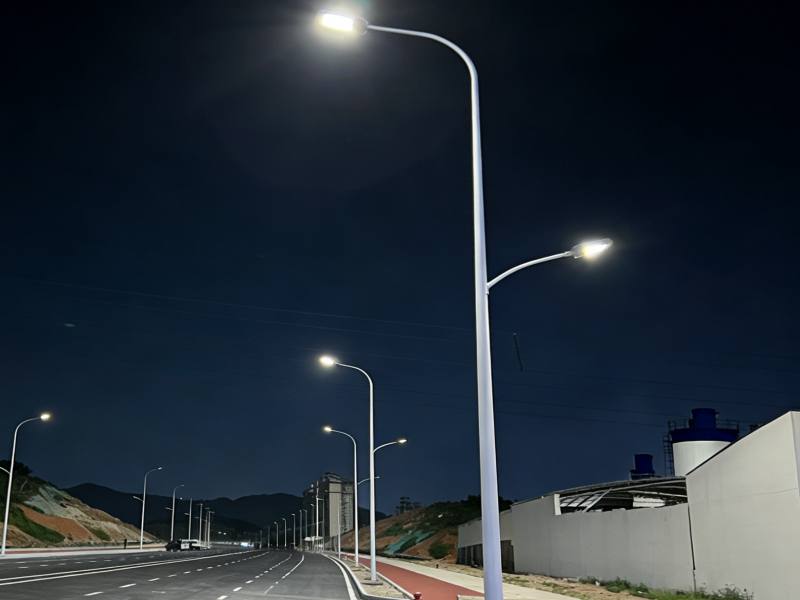
II. Lighting Performance of LED Street Lamp Fixtures
The ability of LED street lamp fixtures to illuminate roads, including light source brightness, illumination uniformity, color uniformity, illuminance, and beam control, is referred to as their lighting performance.
1. Light Source Brightness
Light source brightness, which is measured in cd/m², is a crucial component for LED street lamp fixtures. A minimum brightness of 500 cd/m² is usually required for LED street lamp fixtures. High light source brightness enhances streetlight illumination, maintaining road safety.
2. Illumination Uniformity
“Illumination uniformity” refers to the even distribution of illumination light over the road’s surface. The optimal outcome for LED street lamp fixtures is an illumination uniformity of 0.7 or higher, which denotes incredibly uniform road illumination. High illumination uniformity improves road safety and reduces driver fatigue at night.
3. Color Uniformity
Color uniformity is the amount of color variation that happens while an LED street lamp fixture illuminates. There is less color variation during illumination when an LED street lamp fixture has a color uniformity of 0.5 or higher, which enhances visual comfort and produces a more uniform road surface color.
4. Illuminance
The amount of light intensity per unit area, measured in lux, is referred to as “illuminance”. The lighting needs of various road segments are taken into consideration when designing LED street lamp fixtures’ illumination. For instance, nearby roads need comparatively lower illumination, usually 30–40 lux, while main roads need higher illumination, usually 50–80 lux.
5. Beam Control
To adapt to various roads and environments, LED street lamp fixtures need control over the beam’s direction and range. While general illumination is required for some roads, localized illumination is necessary for others. The light source must be able to be adjusted in accordance with the requirements of the particular road section because variations in the lamp head angle can impact the illumination and condition of the light source.
Post time: Jan-20-2026


