
As cities around the world continue upgrading their lighting infrastructure, LED road lights have become the mainstream choice thanks to their energy efficiency, long lifespan, and low carbon footprint. Even so, no fixture is completely maintenance-free. Drivers fail, surge events happen, and dust or moisture can eventually cause problems. For customers, the real question is not whether maintenance will be needed, but how much time, money, and manpower it will cost. Choosing the right LED street light fixture at the procurement stage can dramatically reduce long-term maintenance pressure. So what kind of LED street light fixtures are actually easier to maintain?
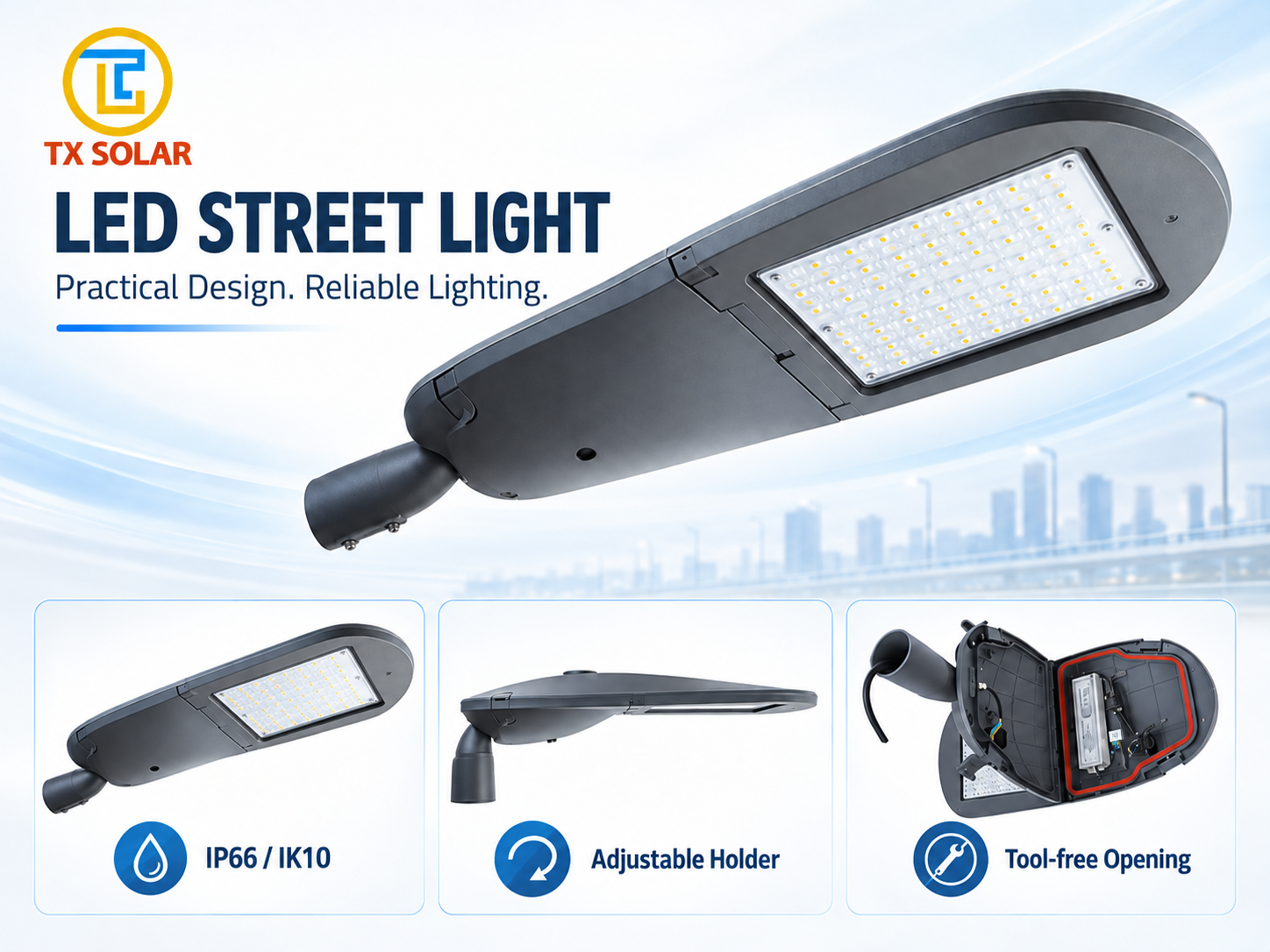
1. Modular Design
Modular LED road lights are widely considered the easiest to service. In a modular fixture, the LED light engine, driver, surge protection device, and sometimes the photocell are designed as independent replaceable units. If one module fails, the technician replaces only that module instead of the whole luminaire. This lowers material costs, shortens on-site repair time, and reduces the risk of damaging working components during servicing. For large-scale municipal projects, modularity also simplifies spare parts planning.
2. Tool-Free and Front-Opening Access
How a LED street light fixture opens matters more than many buyers realize. Fixtures that allow tool-free or front-opening access let maintenance crews reach the driver compartment or wiring terminals directly from the street side. Traditional rear-opening housings are awkward to handle on a boom lift, especially in bad weather or heavy traffic. A front-opening design with captive screws or quick-release latches can cut service time significantly and improve worker safety at height.
3. Standardized, Interchangeable Components
Fixtures built around standardized interfaces—common LED module footprints, universal driver connectors, and standard mounting brackets—are much easier to maintain. Replacement parts are more widely available, and components can often be shared across different models or batches. This reduces inventory pressure, shortens the waiting time for spares, and avoids the situation where an obsolete LED street light fixture forces a full replacement simply because one small part cannot be sourced.
4. Strong Thermal Management and Sealed Protection
Thermal design and sealing may seem like performance issues rather than maintenance issues, but they are directly connected. Good heat dissipation slows lumen depreciation and extends the life of LEDs and drivers. A proper IP66 or IP67 seal keeps out dust, moisture, and insects, which are common causes of driver failure, short circuits, and corrosion. Fixtures that manage heat and sealing well simply need fewer repairs over their lifetime.
5. Smart Monitoring and Self-Diagnosis
Modern LED road lights equipped with smart control modules can report faults remotely—driver failure, abnormal power consumption, communication loss, or dimming errors. Instead of relying on citizens to report dark poles, the maintenance team receives alerts and can dispatch crews with the correct parts on the first visit. This predictive, data-driven approach reduces repeat site visits and improves overall service levels.
6. Practical Tips for Procurement
When comparing suppliers, customers should ask specific questions: Can the driver be replaced without removing the whole fixture? Are spare modules available for at least five to eight years? Is the opening direction convenient for lift-based work? Does the fixture support the smart control protocol your city already uses? The answers often matter more than a slightly lower unit price.
Conclusion
The LED street light fixtures that are easiest to maintain share a clear set of features: modular construction, tool-free front access, standardized interchangeable parts, robust thermal and sealing protection, and smart monitoring capability. Prioritizing these characteristics during selection will reduce maintenance frequency, lower total cost of ownership, and make daily operations far more efficient.
Post time: Oct-10-2026


