
Double-arm streetlight poles are core facilities for lighting municipal roads, industrial parks, and rural roads. A reasonable layout design can guarantee the road lighting is uniform without dark areas, control the project cost, improve the road aesthetics, and balance the traffic safety and the durability of the facility. We share three core layout design techniques of double arm lighting pole for road applicable to various outdoor road lighting scenarios, based on standard lighting engineering construction standards.
A. Scientifically Control Height and Spacing to Solidify the Lighting Foundation
Adequate brightness and avoiding blind spots are important and require reasonable pole height and spacing. Design accuracy has to be adapted to the road width.
First, match the height to the width of the road. Standard two lane roads are preferred to have double arm lighting pole for road height of 6-8 meters. 9-12 meters can be used for urban arterial roads and wide highways. This ensures that the double-arm lights can fully cover both lanes, so that there will be no problems of insufficient brightness due to excessive height and limited illumination range due to insufficient height.
Second, standardize the spacing of streetlights. Maintain a spacing of 30-35 meters on ordinary municipal roads, and reduce it to 25-30 meters on rural side roads and park roads. Increase the spacing appropriately in key areas such as intersections and curves to eliminate lighting blind spots in areas with high traffic and pedestrian flow.
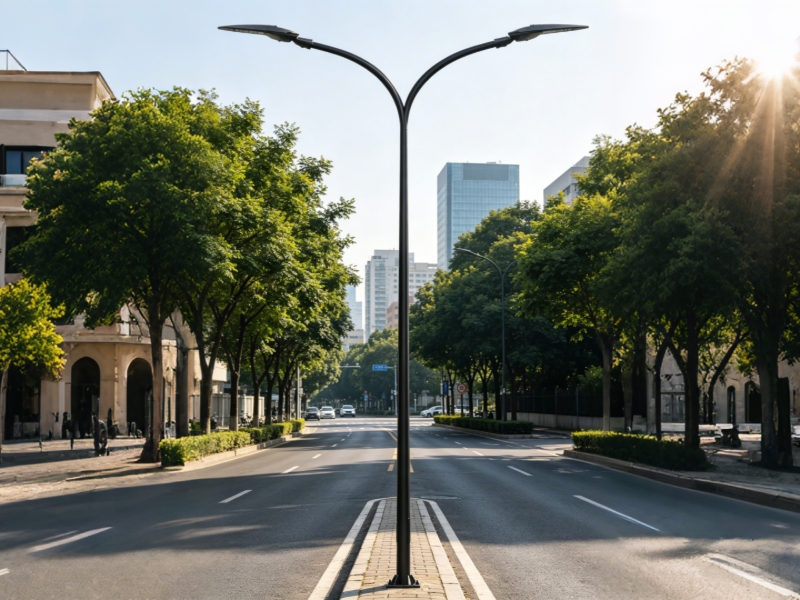
B. Standardize Symmetrical Layout To Improve Overall Appearance And Effect
The symmetrical layout of double-arm streetlight poles is key to the aesthetics and lighting balance of road lighting. A unified layout improves road regularity.
First, adopt a double-sided symmetrical layout. Prioritize double-sided symmetrical layouts on straight, level main roads. Align the two arm lamps horizontally and at the same height, ensuring balanced lighting brightness on both lanes. This effectively avoids uneven light and shadow on the road surface caused by single-sided lighting, suitable for urban main roads and scenic roads.
Second, align the layout with the road baseline. All double arm outdoor light poles must be installed parallel to the road edge line, with consistent arm tilt angles and extension lengths to prevent misalignment. This guarantees the visual tidiness and consistency, standardizes the angle of light illumination and enhances the uniformity of lighting.
C. Practicality and Safety versus Optimization for Different Scenarios
The layout design should be adapted to local conditions, as different road scenarios have different requirements. Lighting should be practical, while ensuring the traffic flow and the safety of the facilities.
First, prevent obstacles to accurate placement. Avoid obstructions like roadside trees, traffic signs, and utility poles when positioning lights. Keep double arm outdoor light poles and trees and buildings a reasonable distance apart so that branches and leaves do not block the light and do not block visibility of traffic and pedestrian passage.
Second, differentiated design for special road sections. For slopes, curves, and intersections, the position of the light poles and the angle of the light arms can be fine-tuned, and the spacing between installations can be appropriately reduced. In residential areas and school roads, the height of the double arm outdoor light poles can be lowered and the angle of the light beam softened to avoid glare and disturb residents, achieving a balance of lighting, safety, and aesthetics.
Tianxiang has been deeply involved in street light pole manufacturing for many years, ensuring standard pole wall thickness and excellent wind and pressure resistance. We conduct full-process testing from raw materials to finished products, offering a complete range of styles and supporting non-standard customization. Sufficient stock and efficient delivery are available. Please contact us for a quote.
Post time: Jun-10-2026


