
First, the deep popularization of AI edge computing will create distributed urban computing nodes.
Currently, integrated smart street poles can only collect basic data. In the future, road smart light poles will incorporate lightweight AI chips and be equipped with millimeter-wave radar, thermal imaging, and high-definition visual multimodal sensors. This will allow for over 90% local data processing at the pole end, eliminating the need for complete cloud transmission and significantly reducing bandwidth and latency costs. The system can autonomously identify anomalies such as vehicle and pedestrian traffic, road damage, falls, and fires, automatically responding in conjunction with traffic lights, emergency broadcasts, and urban management platforms. Simultaneously, it integrates BeiDou high-precision positioning to support L4-level vehicle-road collaboration and autonomous driving, providing centimeter-level road condition perception for unmanned vehicles and constructing a city-wide vehicle-road collaborative network. Digital twin technology will be fully implemented, enabling single-pole real-time collection of environmental, traffic, and equipment data. This data will be mapped onto a 3D city model in the cloud, allowing for congestion prediction and early warning of equipment malfunctions, creating real-time interaction between the physical city and the digital space.
Second, integrated wind, solar, and energy storage will provide self-sufficiency and support low-carbon, sustainable development.
The traditional grid power supply will be gradually modernized. The new generation of integrated smart street poles will incorporate flexible solar panels and small vertical wind turbines to realize all-weather power generation based on solar-wind complementarity through the use of graphene supercapacitors and solid-state energy storage batteries. The lighting modules will automatically adjust brightness according to pedestrian and vehicle traffic, and charging piles and screens will be powered during off-peak hours to build a distributed microgrid. The smart city integrated pole body is made of lightweight carbon fiber material and coated with self-cleaning nano-coating, which can reduce weight, improve corrosion and wind resistance, greatly reduce energy consumption and maintenance costs throughout its service life, and meet the city’s carbon neutrality goals.
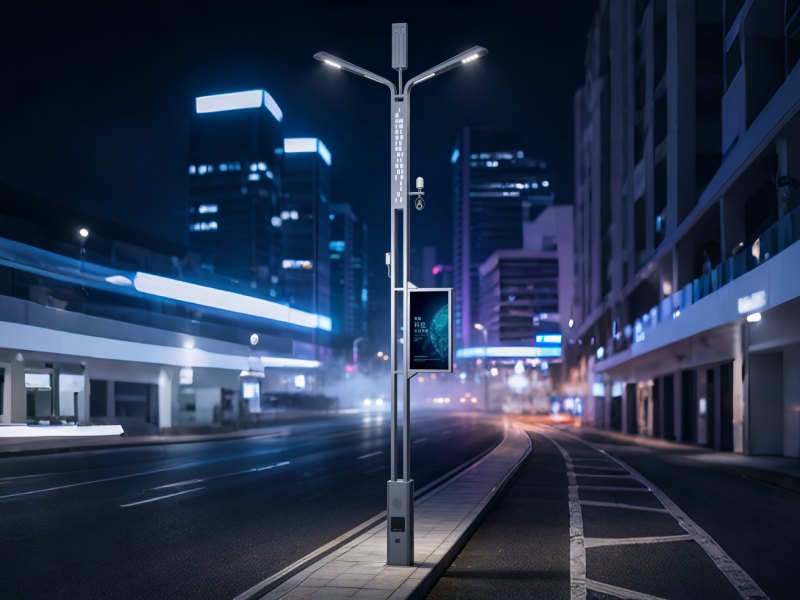
Third, unified modular standards will build an open and interconnected industrial ecosystem.
Previously, incompatibility between equipment interfaces from different manufacturers and redundant construction were prominent issues. In the future, the smart city integrated pole industry will promote a universal modular architecture, allowing modules such as lighting, 5G micro base stations, charging piles, and environmental monitoring screens to be plug-and-play, supporting on-demand additions and subtractions of functions, significantly reducing the cost of transformation and upgrades. Unified communication protocols and data security standards will break down technical barriers between manufacturers and connect data from multiple departments including transportation, urban management, culture and tourism, and emergency response. The operating model will shift from single hardware sale to integrated hardware and software services to create a sustainable profit loop through advertising operation, charging revenue and municipal data services to relieve the burden of one-time government investment.
Fourth, scenario segmentation and integration will broaden the horizons of various urban services.
Main municipal roads will focus on traffic perception and communication coverage; scenic spots and cultural tourism poles will integrate AR interaction, holographic projection, and customized designs based on local culture to create an immersive nighttime experience; parks and communities will be equipped with one-click alarms and smart parking recognition; and lightweight, low-cost, simple smart city integrated poles will be launched in suburban and rural areas, balancing basic lighting and environmental monitoring.
Post time: Jul-08-2026


