
Battery capacity is important when designing a solar street lighting system, but the battery’s installation position can also affect system performance, maintenance, safety, and installation cost.
Depending on the product structure, the battery of solar road lamps may be integrated into the luminaire, hang on the pole, mounted under the solar panel, or placed in an underground battery box. Each option creates different conditions for temperature control, weather protection, cable routing, security, and future maintenance.
Therefore, battery placement of solar road lamps should be selected together with battery type, local climate, project environment, and service requirements.
Why Does Battery Placement Matter?
The battery stores electricity generated by the solar panel during the day and supplies power to the LED fixture at night. Its rated capacity does not change simply because its position changes, but the surrounding environment can influence how conveniently and reliably the complete system operates.
Battery placement may affect:
Operating temperature
Protection from rain, dust, and moisture
Maintenance accessibility
Cable length and voltage drop
Theft and vandalism risk
Installation complexity
Overall appearance
There is no single battery position suitable for every solar road lamp project.
1. Battery Integrated into the Luminaire
In many all-in-one solar street lights, the battery, LED light source, and controller are installed inside one compact luminaire. This structure reduces the number of separate components and simplifies on-site installation.
Integrated solar street lights are suitable for projects that require fast installation, limited external wiring, and a clean appearance. They are also convenient where there is no space for a separate battery box.
However, the battery is located close to the LED module and electronic components, which may generate heat during operation. The luminaire housing must therefore provide effective heat dissipation while protecting the battery and controller from rain, dust, and other outdoor conditions.
2. Pole-Mounted Battery
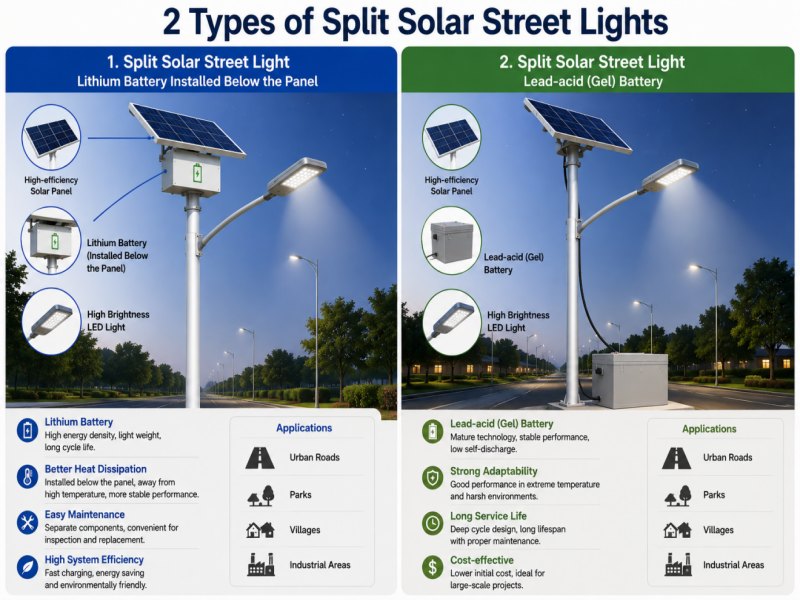
A pole-mounted battery is installed in a aluminum box.This arrangement separates the battery from the LED luminaire and allows the system components to be configured more independently.
One major advantage is maintenance convenience. Technicians may inspect or replace the battery without removing the entire luminaire or excavating the ground. This design can also accommodate different battery capacities and reduce the influence of LED heat.
The installation height must be carefully selected. A battery box installed too low may be vulnerable to unauthorized access, vandalism, or accidental damage. If it is mounted too high, maintenance may require ladders or lifting equipment. The enclosure should also provide reliable protection against rain, dust, and moisture.
3. Battery Installed Near the Solar Panel
Some split solar street lights place the battery high on the pole or under the solar panel. This keeps the energy-storage component away from ground-level interference and may eliminate the need for a separate underground box.
However, a high-mounted solar street light battery may receive stronger sunlight and experience greater temperature changes. Maintenance can also be more difficult because technicians may need to work at height.
When using this arrangement, designers should consider enclosure protection, heat dissipation, installation height, structural loading, and future replacement procedures. The pole and mounting structure must be strong enough to support the additional weight and withstand local wind conditions.
4. Underground Battery Installation
Traditional split solar street lights may use a separate battery box installed underground near the pole foundation. This keeps the battery concealed and preserves the appearance of the pole.
The surrounding soil may help reduce rapid temperature fluctuations, but underground installation creates strict requirements for waterproofing and drainage. The enclosure must be properly sealed, and the site should be evaluated for groundwater, flooding, poor drainage, and heavy rainfall.
Inspection and replacement may also take more time because technicians must open a buried access box or remove surrounding soil. Underground placement is therefore most suitable when the project can provide reliable drainage and convenient access for future maintenance.
5. Temperature and Local Climate
Battery placement should always be considered together with local climate. A pole-mounted enclosure may receive direct sunlight, while a battery integrated into the luminaire may be affected by heat from nearby electronics. An underground battery may experience a more stable temperature but faces greater moisture risk.
In hot regions, designers should pay attention to shading, ventilation, heat dissipation, and enclosure materials. In cold regions, the battery’s low-temperature charging and discharging performance becomes especially important.
The goal is to provide an operating environment suitable for the selected battery technology.
6. Cable Length and Electrical Losses
Battery position also affects the distance between the solar panel, controller, battery, and LED fixture. Longer cables create additional resistance and voltage drop, which may reduce system efficiency if the cables are not properly selected.
The electrical path should be considered as a complete system:
Solar Panel → Controller → Battery → LED Fixture
Cable size should be selected according to voltage, current, distance, and allowable voltage drop. Good solar street light battery placement is therefore both a mechanical and electrical design decision.
7. Maintenance and Security
Solar road lamps are designed for long-term outdoor use, but batteries may eventually require inspection or replacement. Project planners should ask how technicians will access the battery several years after installation.
A pole-mounted solar street light battery may be easy to replace, while a high-mounted battery may require lifting equipment. An underground battery may require access to a buried enclosure. For large projects, even a small difference in maintenance time per unit can significantly affect total service costs.
Security should also be considered. Easily accessible battery boxes may simplify maintenance but increase the risk of theft or vandalism. Lockable enclosures, anti-theft fasteners, internal pole installation, higher mounting positions, or integrated designs can help improve protection.
Choose Battery Placement According to the Project
The best battery position depends on the complete project environment. Designers should evaluate:
Climate → Battery Technology → Installation Environment → Maintenance → Security → System Structure
An integrated lithium battery may be ideal for a compact all-in-one solar street light. A pole-mounted solar street light battery may be more suitable when convenient replacement is important. In other projects, a properly sealed underground battery box may provide a concealed and stable solution.
Battery placement is not an isolated detail. It is part of the overall solar street lighting design. As a professional solar street light manufacturer, TIANXIANG provides integrated and split solar street lighting solutions, including customized batteries, solar panels, controllers, LED luminaires, poles, and installation structures.
Post time: Aug-26-2026


