
A solar powered street light may use the same LED lamp, battery, solar panel and controller throughout the year, but its operating conditions change with the seasons. One of the most important factors is seasonal solar irradiance.
Changes in sunlight affect how much energy the solar panel can generate during the day. This influences battery charging, nighttime runtime, dimming strategies, and overall system reliability. For this reason, designing a solar street lighting system according to annual average sunshine alone may not be sufficient.
What Is Solar Irradiance?
Solar irradiance refers to the amount of solar power reaching a surface. In solar street lighting system design, engineers are mainly concerned with the total solar energy available over a specific period.
This energy is affected by:
Season and geographic location
Day length and solar elevation
Cloud, rain, and snow
Local shading
Solar panel orientation and tilt
Even at the same location, a panel may collect significantly more energy in summer than in winter. Local solar resource data should therefore be considered when selecting panel and battery capacity.
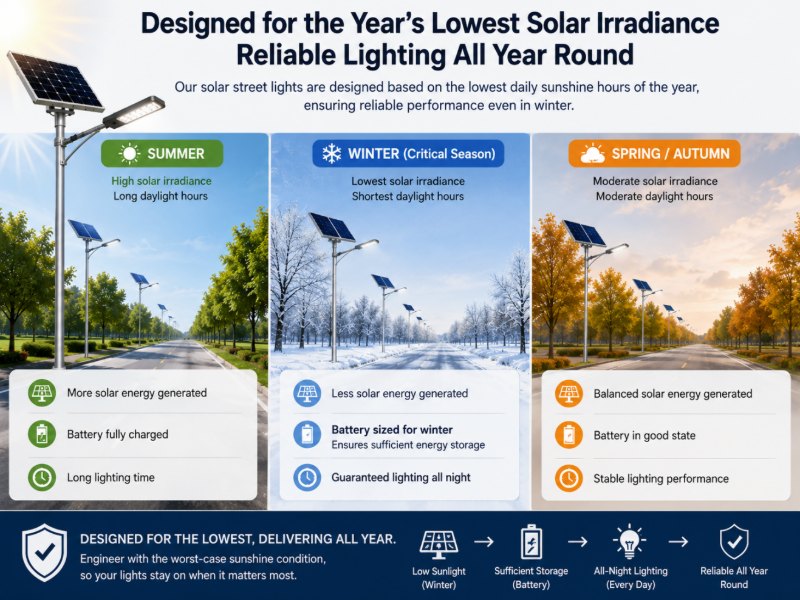
1. Seasonal Changes Affect Daily Energy Generation
During seasons with longer days and stronger sunlight, photovoltaic panels generally have more opportunities to generate electricity. When solar irradiance decreases, daily energy production also falls.
The basic energy flow is:
Available Solar Energy → PV Generation → Battery Charging → Nighttime Lighting
If the panel generates more energy than the light consumes, the battery can usually return to a high state of charge. If generation remains below consumption for several days, the stored energy gradually decreases.
One cloudy day may not cause a problem, but repeated periods of weak sunlight can reduce system runtime.
2. Winter Creates a Double Energy Challenge
Winter is often one of the most demanding seasons for solar street lighting system. In many regions, it brings two changes at the same time:
Less solar energy during the day
Shorter daylight hours and a lower solar angle may reduce charging energy.
Longer lighting hours at night
Earlier sunsets and later sunrises increase the time the solar powered street light must operate.
This creates a simple but important challenge:
Less charging energy + longer discharge time
A system designed only for favorable summer conditions may therefore have insufficient battery capacity during winter. Local solar data and night length should be used instead of relying on general assumptions.
3. Battery State of Charge Changes Over Time
The battery stores energy collected during the day and supplies it at night. After several sunny days, it may remain near a high state of charge. During extended periods of low irradiance, however, it may not fully recharge before the next lighting cycle.
For example:
Day 1: Weak charging → normal nighttime discharge
Day 2: Partial recharge → further battery discharge
Day 3: Smaller energy reserve
This cumulative effect makes consecutive low-sunlight days more important than evaluating only one day’s weather. Battery sizing should consider both daily energy demand and the required autonomy period.
4. Size the Solar Panel for the Critical Season
Annual average solar irradiation is useful for preliminary calculations, but it may hide the most difficult operating period. If a solar powered street light project experiences a long season with low solar energy, designing only according to the annual average could result in an undersized photovoltaic array.
Panel selection should consider:
Local peak sun hours
Seasonal irradiation changes
LED power and operating hours
Charging efficiency and system losses
Battery capacity
Required backup days
The objective is not simply to install the largest panel. The panel, battery, LED power, and controller should be balanced as one complete energy system.
5. Dimming Can Reduce Seasonal Energy Pressure
Many roads do not require maximum light output throughout the entire night. A controller can provide higher output during busy periods and reduce power during late-night hours when traffic is lighter.
A typical profile may be:
100% output → 70% output → 40% output → increased output before morning traffic
The exact settings should follow project requirements and applicable lighting standards. During seasons with limited solar energy, a suitable dimming schedule can reduce consumption while maintaining useful illumination.
6. Consecutive Cloudy Days Affect Autonomy
One cloudy day may not seriously affect solar street light performance if the battery has enough stored energy. Several consecutive days of low solar input can gradually reduce the available reserve.
This is why designers consider autonomy days when configuring the battery. The required autonomy depends on:
Local weather patterns
Nightly energy consumption
Lighting schedule
Battery technology
Acceptable dimming levels
Project importance and budget
Regions with long rainy seasons may require a different configuration from areas with stable sunshine.
7. Temperature and Irradiance Have Different Effects
Solar irradiance determines how much energy the panel can potentially generate. Temperature affects battery charging and discharging, usable battery capacity, electronic components, and photovoltaic performance.
A sunny winter day may still provide useful solar energy despite low temperatures. In contrast, a hot but heavily overcast day may produce less energy than expected. Professional design should therefore evaluate solar resource and temperature as separate environmental factors.
8. Orientation, Tilt, and Shading Matter
A correctly sized panel cannot perform well if its exposure to sunlight is poor. Trees, buildings, utility poles, and signs may cast shadows during certain seasons or times of day.
Project planning should evaluate:
Panel orientation and tilt
Nearby obstacles
Morning and afternoon shading
Seasonal changes in sun position
A site that appears unshaded during one visit may experience partial shading later in the year. Reducing avoidable shading helps the system use available sunlight more effectively.
Use Local Data for Reliable Design
Two projects with identical equipment can perform differently because they are installed in different locations. Before selecting panel and battery capacity, designers should review seasonal solar irradiation, peak sun hours, night length, consecutive low-sun days, temperature range, shading conditions, and the planned lighting schedule.
Seasonal solar irradiance directly affects the energy balance of an off-grid solar powered street light. A reliable solar street lighting system design must determine how much energy the system can collect, how much the light consumes, and how much energy must be stored for low-sunlight periods.
When these elements are properly balanced, solar powered street lights can provide more stable solar street light performance performance throughout the year. As a professional solar powered street light manufacturer, TIANXIANG can configure photovoltaic panels, batteries, LED power, controllers, and operating modes according to local solar conditions and project requirements.
Post time: Aug-26-2026


