
As a provider of solar street poles solutions, we are frequently asked: for streetlights lining a two-way road, is it better to position the street lighting poles directly opposite each other (opposite arrangement) or to stagger them (staggered arrangement)? There is no one-size-fits-all answer; the choice depends on a comprehensive assessment of factors such as road width, traffic volume, lighting standards, and cost.
Two Solar Street Light Layout
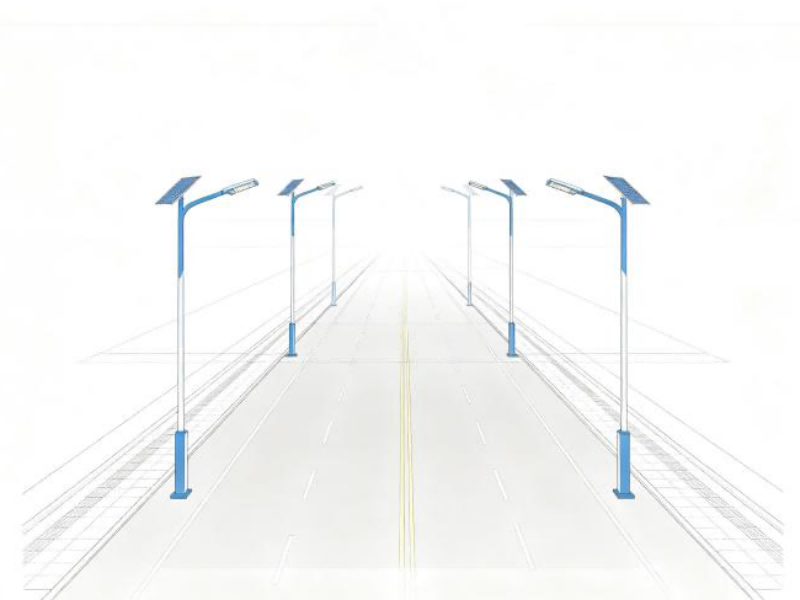
Opposite-type layout: The solar street poles on both sides of the road are placed directly opposite each other.
Staggered layout: Two solar street poles are located on alternate sides of the road, abutting each other.
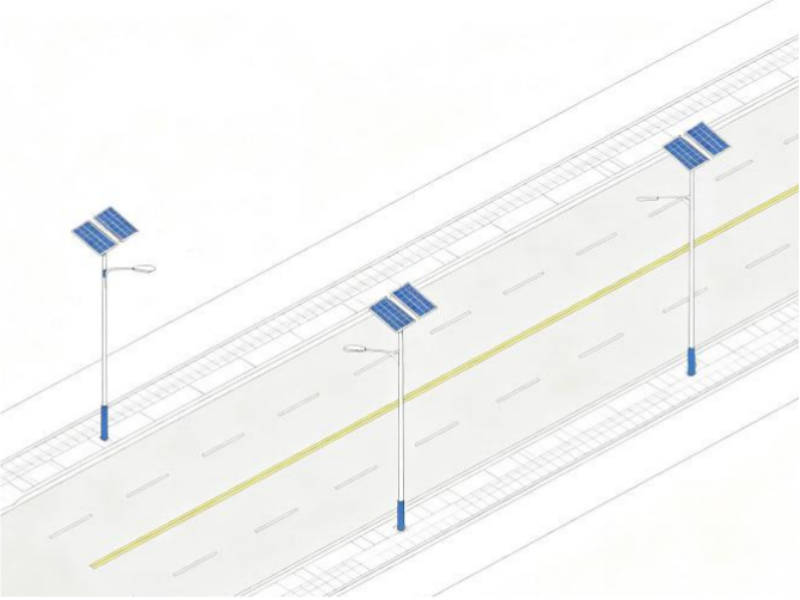
The most immediate difference between the two lies in how the light overlaps: an opposite arrangement causes the light beams to converge directly at the road’s centerline, whereas a staggered arrangement achieves overall uniformity by having the light patterns from successive poles complement one another.
The optimal choice is determined by a systematic analysis of road geometry and specific project lighting objectives.
Engineering principle: spacing and height
The effectiveness of any layout depends on the relationship between pole height (H) and pole spacing (S). A basic heuristic method is to maintain a spacing-to-height ratio (S/H) consistent with the road width and ensure the required uniformity.
For roads of medium width (12m-16m), a staggered layout is often the most effective starting point. It allows for wider pole spacing (typically 30m to 40m), while maintaining sufficient overlap of light beams on alternating sides to ensure good uniformity, without requiring a completely opposite layout.
For wide roads (over 16 meters), the opposite layout of street lighting poles must be adopted. By aligning the solar street poles, this configuration ensures that the light distribution on both sides overlaps in the center, preventing dark spots and meeting the stricter lighting standards required for major roads.
Quantitative and practical insights
Uniformity and Brightness: Data indicates that both the opposing and staggered layouts achieve comparable uniformity ratios in many scenarios. However, on wider roads, both significantly outperform the single-sided layout. The choice often comes down to optical performance and specific project goals, rather than solely relying on apparent advantages in uniformity.
Project-specific optimization: Recent research emphasizes that layout should be a data-driven decision. Using advanced modeling, staggered layouts can be optimized to increase the solar irradiance rate of solar panels to 19.73% and ground irradiance to 23.58%, compared to standard methods. This underscores that carefully designed staggered layouts can be efficient and energy-resilient.
For project planners, this decision represents a classic trade-off:
For medium-width roads where a balance between performance and initial investment is crucial, a staggered layout should be chosen. It provides excellent uniformity and efficient spacing for most municipal and residential projects.
For wide, high-traffic roads, the opposite layout of street lighting poles is chosen, as providing maximum, symmetrical lighting is a non-negotiable requirement for safety and visibility on these roads.
Ultimately, the “better” layout is the one that suits your specific road grade, width, and budget parameters.
Post time: Sep-02-2026


