
How do solar LED street lights cope with the harsh challenges posed by roads with heavy-duty trucks?In industrial zones, logistics parks, ports, and other areas, the frequent passage of heavy-duty trucks imposes significantly higher requirements on road lighting than ordinary urban roads. As a professional manufacturer of solar street lighting, we have leveraged our years of project experience to analyze the key points of lighting design for heavy-duty traffic sections, assisting engineering planners in selecting the right solutions.
Special solar rural road lighting requirements for heavy-duty roads
Heavy-duty trucks have wide bodies and long braking distances, making them extremely sensitive to road surface brightness and uniformity when driving at night. According to the industry’s general standards, the maintained illumination for main heavy-duty lanes should reach 12–20 lux, with a uniformity of not less than 0.4; for secondary roads or loading and unloading areas, it is recommended to have 8–15 lux, with a uniformity of ≥0.3. These indicators are much higher than those for general side roads, aiming to enable drivers to clearly identify road obstacles, vehicle edges, and pedestrians, thereby reducing the risk of accidents.
In addition, heavy-duty roads are often located in remote industrial areas where power grid coverage is incomplete or the cost of capacity expansion is high. Solar LED street lights, with their advantages of independent power supply and no need for cable trench construction, have become an ideal choice. However, special design enhancements must be made to address environmental factors such as vibration, impact, and dust.
Structural strength: fully equipped from the pole body to the lighting fixture
The continuous low-frequency vibration generated by the movement of heavy vehicles can gradually loosen the bolts of ordinary lighting fixtures, damage the battery connection straps, and even cause the lamp head to deviate. Therefore, the wall thickness of the lamp post is a primary indicator: for a common height of 10 to 12 meters, it is recommended that the wall thickness be no less than 3.5 to 4.0 millimeters, using Q235 or higher strength steel, and applying a dual anti-corrosion treatment of hot-dip galvanizing and powder coating to ensure no rusting in coastal or high humidity areas.
The lamp housing is made of die-cast aluminum alloy through integral molding, with increased wall thickness. The surface undergoes UV-resistant powder coating, ensuring an overall protection level of IP65 or higher. It is capable of resisting dust and high-pressure water jetting. Additionally, the lamp must possess IK08 impact resistance to prevent damage from flying stones on the road or minor vehicle scrapes.
Anti-vibration and wind-resistant design: reliability hidden in the details
To address the vibration issue, we utilize locknuts and shock-absorbing rubber pads at the connection points of the brackets, and employ a patented locking structure to prevent angular deviation caused by long-term vibration. The frame of the photovoltaic panel is made of thickened aluminum alloy, and the glass is processed using tempered laminated technology, making it less prone to breakage even in the face of severe bumps. The entire system of solar rural road lighting has also undergone simulated vibration table testing to ensure that the solder joints of internal components, such as the battery pack and controller, are secure.
In open industrial areas, wind loads cannot be ignored. By reasonably designing the taper of the pole, the dimensions of the foundation, and the windward area of the lighting fixtures, stability can be ensured even under a Category 12 typhoon. In engineering projects, the volume of foundation concrete should be calculated based on local wind speeds, and it is usually not less than 1.2 meters × 1.2 meters × 1.5 meters.
Targeted optimization of photovoltaic and energy storage systems
Heavy-duty roads are often surrounded by dust or blocked by tall buildings. Solar panels should be made of high-efficiency monocrystalline silicon wafers with a conversion efficiency of over 21%, and their surfaces should be coated with a self-cleaning layer to reduce the impact of dust accumulation. The installation inclination is recommended to be set between 15° and 30° according to the latitude, facing directly south (in the northern hemisphere), in order to maximize the daily average power generation.
Energy storage batteries are the core to ensure continuous lighting at night. We recommend using lithium iron phosphate or ternary lithium-ion cells, which have a wide temperature range (-20°C to 60°C) operating capability and a cycle life of over 2000 cycles. The controller needs to have multiple protections such as overcharge, overdischarge, short circuit, reverse polarity, lightning protection, and support intelligent dimming – for example, fully illuminating during the first half of the night and automatically reducing power according to traffic flow during the second half of the night, which ensures safety and extends the battery life during rainy days. Generally, the battery capacity is configured based on 8 hours of lighting per day for 3 consecutive rainy days.
Actual project reference
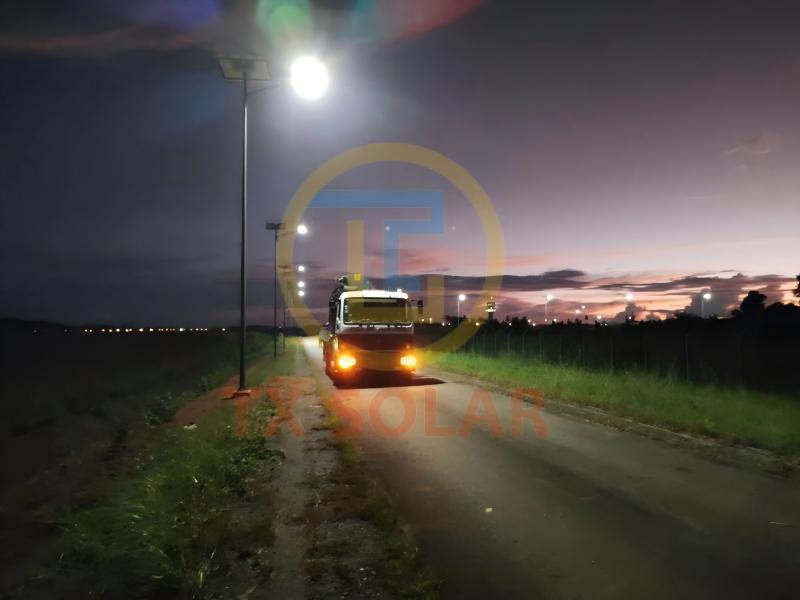
On the main road of a large manufacturing base in Southeast Asia, we deployed relative solar LED street lights with a pole height of 12 meters and a spacing of 35 meters. We chose 120W LED light sources and 360W photovoltaic panels, paired with 2.4kWh lithium batteries. After two years of operation, the measured average illumination of the road surface was 14.5 lux, with a uniformity of 0.42, fully meeting the requirements for nighttime operations of heavy-duty vehicles, and no malfunctions caused by vibration occurred. Similar solutions have also been successfully applied in multiple port logistics parking lots in China.
Conclusion
When selecting solar street lighting for heavy-duty truck roads, it is not a simple matter of applying conventional models. Instead, comprehensive considerations should be made from dimensions such as structure, vibration resistance, dust prevention, and energy storage.
Post time: Sep-02-2026


