
A common frustration in the solar lighting industry is the “garbage in, garbage out” phenomenon. Many buyers request a quotation about solar lighting with just a pole height and quantity, only to receive a system that underperforms. To design a reliable, cost-effective solution, solar street light manufacturers don’t guess—they calculate. Here are the 7 essential data points you must provide to get an accurate, performance-guaranteed proposal.
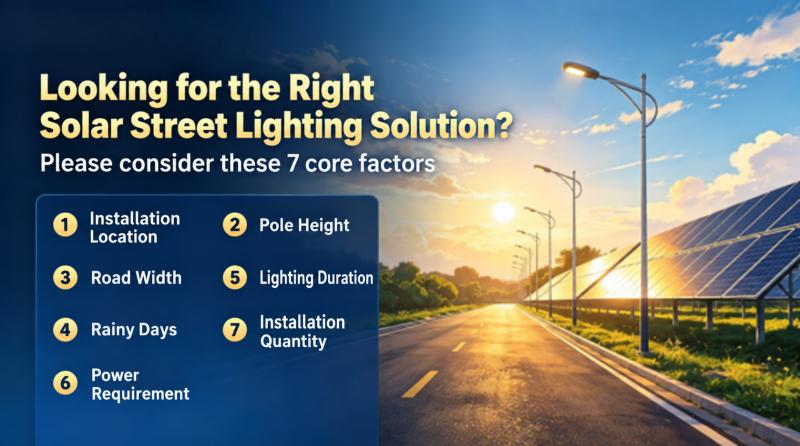
1. Precise Installation Location (Geographical Coordinates)
This is non-negotiable. Solar radiation varies dramatically by latitude and climate. Provide the city, state, or even GPS coordinates. This allows us to check the Peak Sun Hours (PSH) data from NASA or local meteorological databases. A system designed for 5.0 PSH in Arizona will fail miserably in 3.2 PSH in Seattle.
2. Roadway Dimensions & Layout
We need the road width, distance between poles, and the number of lanes. Is it a straight path, a T-junction, or a roundabout? This determines the required optical beam angle (Type I, II, or III) and the mounting height. For example, a 6-meter-wide road requires a different lens than a 12-meter highway.
3. The Lighting Standard or Lux Requirement
Don’t just say “bright enough.” State the specific standard you are working towards. Is it EN 13201 (European), IESNA (American), or a local municipality code? Alternatively, provide the required Average Lux (luminance) and Uniformity Ratio (U0) . Typically, residential roads need 15-20 Lux, while highways require 30-50 Lux.
4. Operating Time Profile (The “Time Schedule”)
How do you want the light to behave each night? Provide a time schedule. For instance:
0-5 hours after sunset: 100% power.
5-8 hours: 50% power.
8 hours to dawn: 30% power.
This profile directly impacts the battery capacity and solar panel wattage calculations.
5. Autonomy Days (Backup Power Requirement)
This is the number of consecutive rainy/cloudy days the system must survive without sunshine. Industry standard is 3 to 5 days. Don’t forget to specify if you require ”guaranteed operation” (lights stay on at reduced brightness) or ”guaranteed full brightness” (much larger battery required). This is where cost varies most.
6. Ambient Temperature Range
Batteries, especially Lithium-ion, are temperature-sensitive. Tell us your local minimum winter temperature and maximum summer temperature. If you are in the Middle East (50°C+), we need active cooling or LiFePO4 batteries. If you are in Canada (-30°C), we must add a heating pad to the battery pack to enable charging.
7. Specific Certifications & Installation Preferences
Do you require IES/LM-80 reports for LEDs? DLC or CB/CE certification for customs clearance? Also, define the mounting type: slip-fitter, tenon, or side-entry? And finally, what is the allowed wiring distance from the solar panel to the lamp (if separated)?
The Bottom Line:
A professional solar street light supplier will never start designing without this data. The more detailed your answers, the smaller the tolerance margin we need to add for safety. This saves you 10-30% in unnecessary costs while guaranteeing the system works exactly as promised. When in doubt,ask your solar street light manufacturer for a “Project Data Sheet” to fill out—it ensures nothing is missed.
Post time: Sep-10-2026


