
For a solar street lighting project, the completion of installation is not the end but the beginning of a maintenance cycle that lasts for several years or even ten years. As a production enterprise with over 18 years of experience in the street lighting manufacturing industry, Yangzhou Tianxiang during its service of numerous projects in Africa, Southeast Asia, has discovered that a complete maintenance data record is the key basis for ensuring the long-term stable operation of the project and clarifying the quality warranty responsibilities.
In many solar street lighting projects, when a fault occurs, due to the lack of historical maintenance records, it is often impossible to determine whether it is a defect of the product itself or improper later maintenance, ultimately resulting in unnecessary disputes and losses. Then, what solar street light maintenance data should systematically record?
1. Component-level identity and location mapping data
This is the cornerstone of the maintenance record. Each solar street lamp should have an independent “identity file”, binding and mapping the lamp post number, GPS coordinate position, and core component serial number. Specifically, it includes: the power of the solar panel and the serial number, the type and capacity of the battery (lithium iron phosphate or lead-acid), the model and parameters of the controller, the power and light efficiency of the LED lamp, and the material and height of the lamp post. When a certain street lamp has an abnormality, maintenance personnel can quickly trace the specific configuration and factory information of the equipment to avoid secondary faults caused by incompatible component models.
2. Inspection and operation status data
Daily inspections should not only record the simple conclusion of “normal/abnormal”, but also quantitatively record key operating parameters. The surface cleanliness and shading of the solar panel need to be evaluated and recorded regularly, as it directly affects the charging efficiency. The voltage, internal resistance, and charging and discharging status of the battery are the core indicators for judging the health of the energy storage system, especially after continuous rainy weather, it is necessary to focus on recording the recovery of charging and discharging. The working status of the controller and the setting of the dimming parameters are also not to be ignored, including the lighting time, dimming power level, and whether there are abnormal reset records.
3. Fault and disposal records
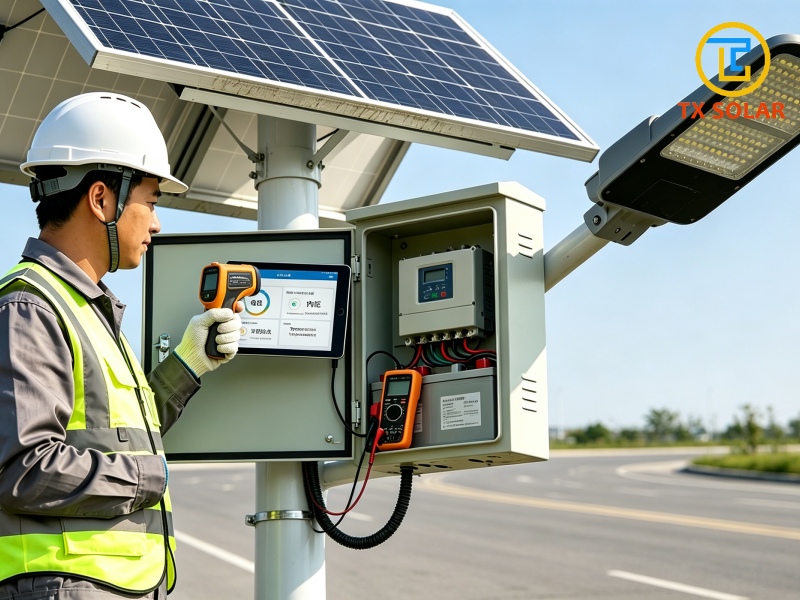
Every fault is an opportunity for improvement. When a solar street lamp fails to light up, flickers, or has abnormal lighting time, detailed records of the date of occurrence and specific phenomenon description should be made, clearly determining whether it is a single solar street lamp fault or a regional system problem. The disposal process should record the determination of the root cause (such as battery aging, controller damage, loose wiring, solar panel shading, etc.), the model and serial number of the replaced components, as well as the completion time and acceptance conclusion of the maintenance. After accumulating a certain amount of data, these can help manufacturers and maintenance personnel identify the weak links of the product and provide empirical reference for the selection and configuration of subsequent projects.
4. Environmental and periodic data
The performance of solar street lamps is highly dependent on the climate and light conditions of the installation location. Recording the number of consecutive rainy days, extreme temperature events, and the degree of dust or salt spray erosion helps to reasonably explain the performance fluctuations during certain periods and avoids misjudging environmental factors as product quality issues.
For solar street lamp manufacturers, a complete, continuous, and traceable maintenance data record is not only a professional manifestation of after-sales service, but also an important input for product iteration and quality improvement.
Post time: Sep-18-2026


