
Solar street light dimming profile is not simply “lowering the brightness to save energy”, but rather finding a balance between lighting safety and energy sustainability. The dimming logic should vary for different traffic flow sections.
1. High-traffic sections: Stability priority
Urban main roads, national highways, etc. have continuous night-time traffic flow, requiring high requirements for lighting continuity and uniformity. It is recommended to adopt the “base power + small fluctuations” mode. From evening to early morning, maintain 80% – 100% output, and reduce to 60% – 70% in the late night. It is not advisable to go lower. Such sections should not rely mainly on sensor triggering; frequent fluctuations in lighting will affect the driver’s visual adaptation. A more reasonable approach is to combine historical traffic data to preset a smooth power curve.
2. Medium-traffic sections: Time-based adjustment
Urban secondary roads, county roads, etc. have obvious peak and valley changes in traffic flow. It can adopt time-based fixed dimming: 100% power from sunset to 23:00; 50% – 60% from 23:00 to 2:00 a.m.; further reduced to 30% – 40% from 2:00 a.m. to sunrise. This scheme is simple in logic, the battery consumption is predictable, and combined with MPPT charging control, it can usually achieve stable operation throughout the year.
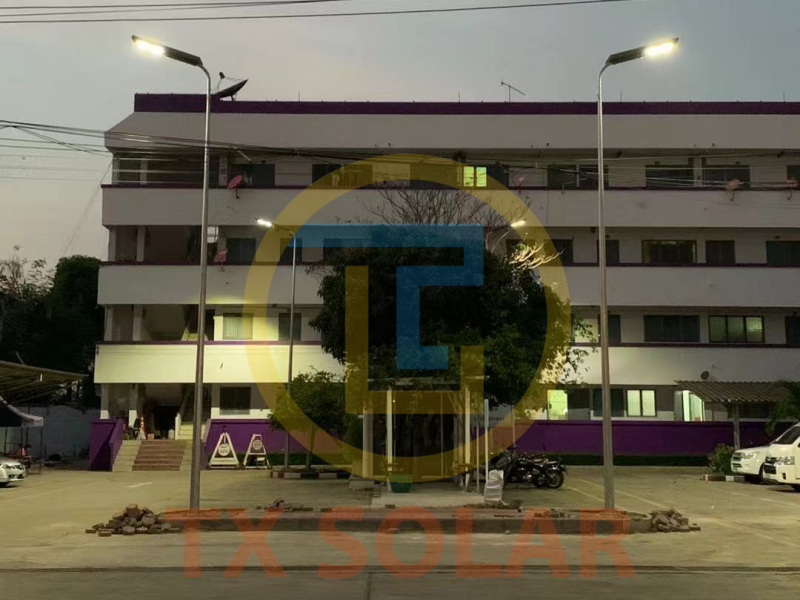
3. Low-traffic sections: Sensor-triggered mainly
Rural roads, remote mountainous roads, etc. have scarce night-time traffic flow, suitable for the “base dim light + sensor full power” strategy. Maintain 10% – 20% basic lighting when there is no traffic to allow distant vehicles to sense the road outline; when a target is detected by microwave radar or infrared sensor, it rises to 100% power within 1 second, and then returns to the original level after the target leaves, avoiding frequent switching shocks to LEDs and batteries. It is necessary to pay attention to the sensitivity calibration of the sensors to prevent false triggering.
4. Unignored variables: Battery state linkage
Continuous rainy days are the biggest challenge for solar street lights. The dimming scheme should introduce a battery state linkage mechanism: operate according to the standard strategy when the battery is fully charged; switch to the energy-saving curve when the battery level is below 30%; prioritize ensuring the sensor triggering capability when the battery level further drops, and reduce the basic power consumption. This can be achieved through a programmable controller without additional hardware.
5. The core principle of scheme selection
First, safety cannot be compromised; during low-power periods, the minimum requirement should be able to identify road edges and obstacles; second, match the local real traffic patterns, do not copy parameters from other projects; third, the energy consumption budget should be designed based on the longest consecutive rainy days in the local area, rather than based on sunny days; fourth, the scheme can be iterated, and through actual operation data, continuously optimize after installation.
A good solar street light dimming logic scheme is not to make the lights “dimmer”, but to ensure that each kilowatt-hour is used at the most needed time and location.
We are TX Solar, China Solar street light and poles Manufacturer. We have been deeply involved in this industry for 18 years, with a professional team, advanced technology and excellent sales capabilities. If you are interested in solar street light dimming logic or have any questions, please feel free to contact us!
Post time: Sep-18-2026


